
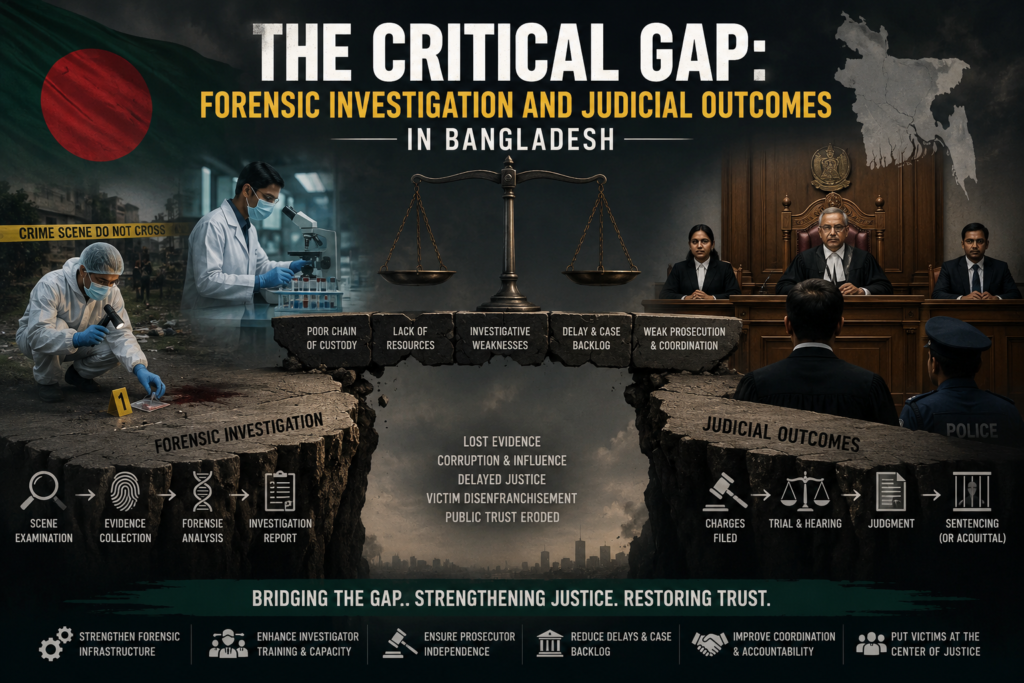
In any modern criminal justice system, forensic investigation is the bedrock of truth. It translates silent physical evidence—DNA, fingerprints, ballistic marks, and digital trails—into undeniable facts. Beyond convicting the guilty, forensics plays a uniquely compassionate role: it acts as a voice for the victim, reconstructing their final moments and revealing the objective truth of what happened to them when they can no longer speak for themselves.
In Bangladesh, however, the criminal justice system remains heavily reliant on ocular evidence (eyewitness testimony) and confessional statements. While the world has embraced advanced forensic methodologies, Bangladesh faces systemic challenges that prevent its investigative procedures from reaching international standards.
1. The Power of Forensics: Speaking for the Victim
When a serious crime occurs, eyewitnesses can be compromised, intimidated, or turn hostile. Memories fade, and oral testimony can be manipulated. Forensic science, by contrast, does not lie.
- Reconstructing the Event: Proper crime scene management allows investigators to determine the sequence of events, the distance from which a weapon was fired, or whether a victim’s injuries match a claim of self-defense.
- Establishing Consent and Intent: In complex cases involving sexual offenses or suspicious deaths (often staged as suicides), high-standard forensic analysis of trauma marks, toxicology, and DNA is the only way to establish the true nature of the crime, ensuring the victim’s experience is accurately represented in court.
2. Current Challenges in Bangladesh’s Forensic Methodology
While Bangladesh possesses capable individual experts and institutions like the Forensic DNA Laboratory of the Criminal Investigation Department (CID) and the National Forensic DNA Profiling Laboratory (NFDPL), the overall ecosystem falls short of standard global methodology.
A. Contamination of the Crime Scene
The first few golden hours after a crime are crucial. In Bangladesh, crime scenes are rarely cordoned off effectively. Curious onlookers, first responders, and even untrained media personnel routinely disturb the area.
The Methodology Deficit: Standard procedure dictates strict chain-of-custody protocols and the use of specialized evidence collection kits. Without these, vital trace evidence such as latent fingerprints or touch DNA is permanently contaminated or destroyed before a forensic team arrives.
B. Over-Reliance on Ocular Evidence
Section 45 of the Evidence Act, 1872 permits the opinion of experts, but the legal system historically favors oral testimony. Investigations often prioritize securing a confession or finding an eyewitness over systematically gathering scientific proof. This leaves cases highly vulnerable to corruption, political pressure, or witness retraction.
C. Resource Limitations and Autopsy Deficiencies
Except for a few central laboratories in Dhaka, regional medical colleges and district hospitals face a severe shortage of modern forensic tools.
- Post-mortem examinations are frequently conducted under poor lighting conditions, lacking advanced radiological tools (like digital X-rays or CT scans) to spot deep-tissue trauma.
- Toxicology reports from the Chemical Examiner’s Department often take months to return, severely delaying the filing of police charge sheets.
3. The Consequences of Substandard Forensics
The gap between domestic practices and international forensic standards has direct, severe consequences on the rule of law.
| Consequence | Impact on Justice |
|---|---|
| High Acquittal Rates | Cases built purely on witness testimony collapse in court if witnesses are compromised, letting perpetrators walk free. |
| Prolonged Trials | Delay in forensic reporting slows down the entire judicial process, violating the victim’s right to a speedy trial. |
| Risk of Wrongful Conviction | Without scientific verification, innocent individuals can be wrongfully convicted based on fabricated oral evidence or coerced confessions. |
4. The Path to International Standards
To modernize its methodology and ensure victims receive the highest quality of justice, Bangladesh must undertake structural reforms:
- Legislative Modernization: The Evidence Act, 1872 and the Code of Criminal Procedure (CrPC), 1898 need comprehensive amendments to mandate forensic and digital evidence collection in all major offenses.
- First Responder Training: Police constables and sub-inspectors must undergo mandatory certification in basic crime scene preservation and evidence handling.
- Decentralization: Advanced forensic labs, toxicology units, and DNA matching facilities must be established at the divisional level to eliminate the bottleneck in Dhaka.
Without standard forensic methodologies, the true narrative of a victim’s final moments is often buried beneath paperwork and conflicting statements. Elevating the standard of forensic science is no longer a luxury for Bangladesh—it is an absolute necessity for the integrity of its judicial system.