
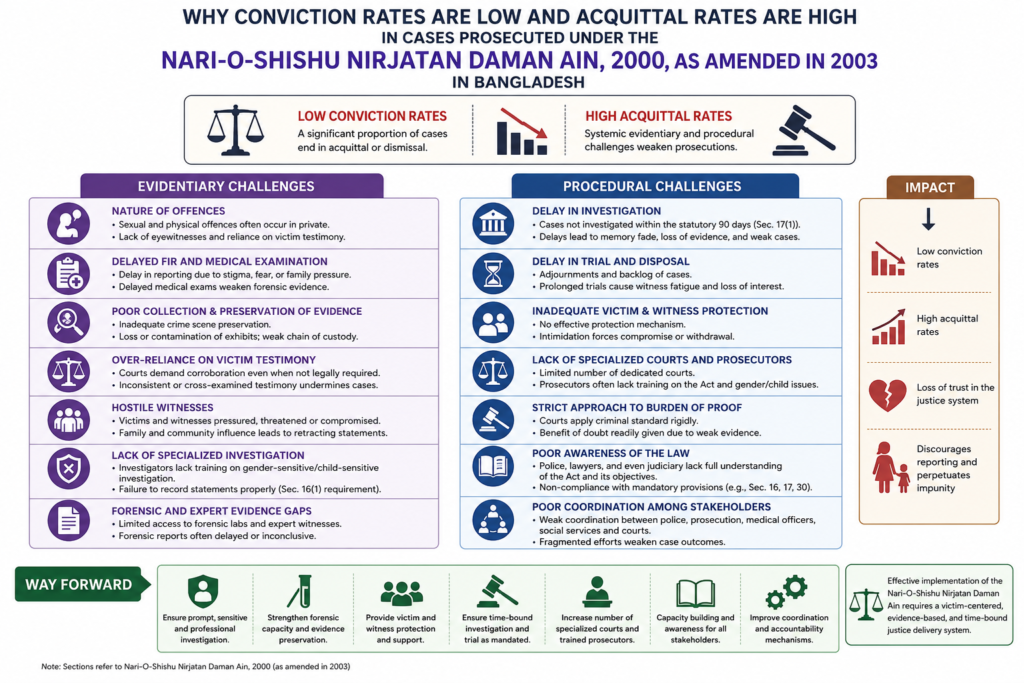
Why conviction rates are low and acquittal rates are high in cases prosecuted under the nari-o-shishu nirjatan daman ain, 2000, as amended in 2003 in bangladesh
Partha Sharathi Ray
Advocate Appellate Division Supreme Court of Bangladesh
Email:lawpartha@gmail.com
1. The Legal Demarcation between Rape and Consensual Partnership
One of the most complex issues facing trial courts is differentiating between statutory rape and consensual
Cohabitation that has deteriorated due to external disputes.
The Promise of Marriage (Biye-r Prolovon): A significant volume of litigation arises when an ongoing,
mutually consensual relationship terminates without marriage. If the relationship involved physical
Intimacy based on a broken promise of marriage, it is often prosecuted as rape.
The Judicial Threshold: Under Section 375 of the Penal Code, 1860, the prosecution must prove that
Consent was obtained through coercion, fear, or active misrepresentation from the very inception of the
relationship. When the defense establishes historical mutuality, the trial court frequently finds that the
elements of criminal force or lack of consent are not proven beyond a reasonable doubt.
2. Defective Plaints and Procedural Anomalies
The structural integrity of the First Information Report (FIR) or the initial complaint under Section 9 of the Ain of
2000 determines the trajectory of the trial.
Delayed Filing: In many instances, an extreme delay occurs between the alleged incident and the lodging
of the FIR. While delay is not fatal if reasonably explained, unexplained delays often create a presumption
of afterthought or external manipulation.
Material Contradictions: Variations between the initial statement given to the police, the statement
recorded under Section 164 of the Code of Criminal Procedure (CrPC), and the testimony delivered during
cross-examination often weaken the prosecution’s case.
3. Forensic and Medical Evidentiary Gaps
Sustaining a conviction requires an unbroken chain of medical evidence. In practice, forensic limitations frequently
result in acquittals:
Absence of Semen & Biological Matter: If the medical examination is conducted late, biological fluids,
including semen, are absent.
Flawed or Delayed DNA Profiling: Delays in biological sample collection can lead to degraded DNA.
Without affirmative DNA matches or signs of physical struggle (extra-genital injuries), the case relies
solely on oral testimony, which is vulnerable to cross-examination.
4. Litigious Misuse and Collateral Disputes
The severe penal consequences of the Nari-O-Shishu Nirjatan Daman Ain, which includes life imprisonment and the
death penalty, are sometimes leveraged in collateral civil or criminal disputes.
Land and Financial Disputes: Trials occasionally reveal that allegations are rooted in pre-existing
property disputes or financial disagreements between families, where the complainant is utilised to exert
leverage.
Out-of-Court Settlements: When cases arise from negotiable or mutual benefits, the complainant or key
hostile witnesses often fail to support the prosecution’s narrative at trial, leading directly to an acquittal for
lack of hostile evidence.
Key Takeaway: For the justice system to effectively penalise genuine offenders while protecting the
innocent, there is an urgent need for stricter vetting of complaints at the FIR stage, objective forensic
evidence collection within 24 hours, and clear-cut definitions of the legal boundaries of consent.