
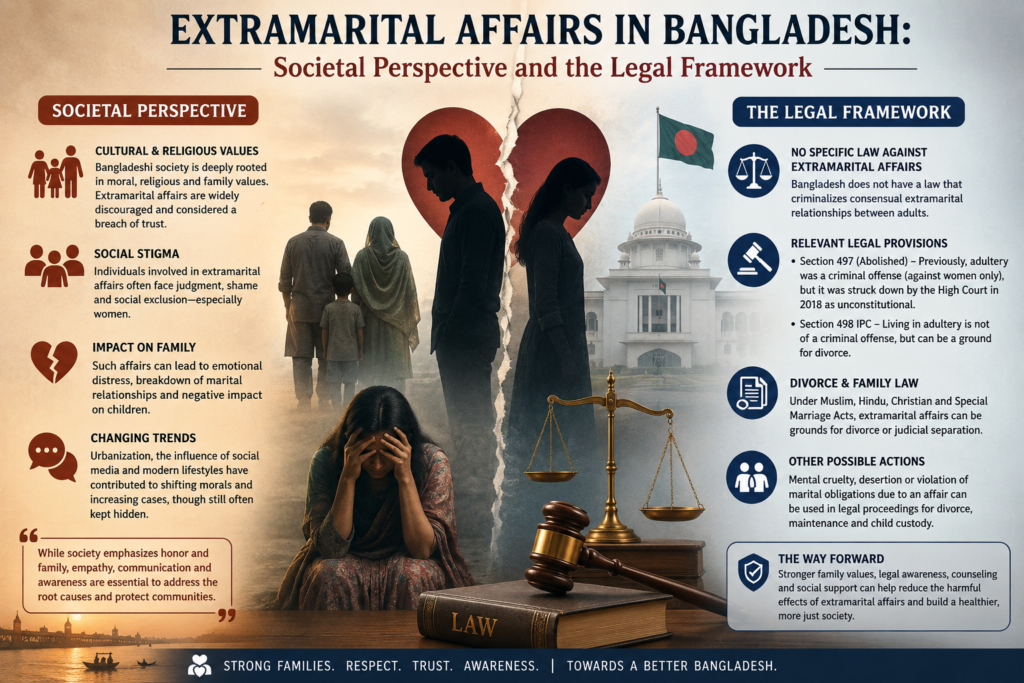
Extramarital Affairs in Bangladesh: Societal Perspective and the Legal Framework
Extramarital affairs, traditionally termed adultery, occupy a complex space in Bangladesh. While deeply condemned by the country’s social fabric and dominant religious values, the statutory laws governing marital infidelity are deeply rooted in British colonial era legislation.
This article explores how extramarital relationships are viewed socially and treated legally under
the current framework of Bangladesh.
1. The Societal Perspective
In Bangladesh, marriage is widely viewed not just as a contract between two individuals,
but as a sacred union between two families. Consequently, extramarital affairs carry an immense social stigma.
- The Impact of Digitalization: The proliferation of smartphones, social media, and instant messaging apps has noticeably changed interpersonal dynamics. Digital platforms have made secret communication easier, making emotional and physical infidelity a major driver behind rising divorce rates in recent years.
- The Gender Bias in Stigma: Although both men and women engage in extramarital relationships, society views them through a gendered lens. Women face far more severe social ostracisation, character assassination, and familial rejection compared to men.
2. The Legal Framework: Section 497 of the Penal Code, 1860
The primary criminal law addressing extramarital affairs in Bangladesh is Section 497 of the Penal Code, 1860. However, the statutory definition of adultery under this colonial law remains highly restrictive and archaic.
What Constitutes Criminal Adultery?
Under Section 497 a criminal offence is established only if a man has sexual intercourse with a woman whom he knows or has reason to believe is the wife of another man without the consent or connivance of that husband.
Distinct Features of the Law
- Only Men Can Be Prosecuted: The law targets the outside man who entered into a relationship with a married woman. It treats him as the sole wrongdoer.
- The Wife is Exempt from Punishment: Section 497 explicitly states that the wife shall not be punished as an abettor. The wife faces zero criminal liability under this statute.
- Husband’s Consent Changes the Offence: If a husband consents to or allows his wife’s relationship with another man, no criminal offence has occurred under Section 497.
- Affairs with Unmarried or Widowed Women: If a married man has an affair with an unmarried woman, a widow or a divorcee, it does not constitute criminal adultery under Section 497.
Punishment: A man found guilty under Section 497 can face imprisonment for a term extending up to five years, a fine, or both.
3. Civil Remedies: Divorce and Family Courts
While criminal prosecutions under Section 497 are relatively rare due to strict standards of proof, extramarital affairs serve as primary grounds for civil action in Family Courts, specifically for divorce (talaq) and the determination of dower (mahr) or maintenance (nafafa).
Under Muslim Personal Law
- For Husbands: A Muslim husband holds the unilateral right to divorce his wife (Talaq) if she is unfaithful, subject to the procedures outlined in the Muslim Family Laws Ordinance 1961.
- For Wives: Under the Dissolution of Muslim Marriages Act, 1939, a wife can seek a judicial divorce if her husband associates with women of evil repute or leads an infamous life.
Under Hindu Personal Law
Hindu law does not traditionally view marriage as a contract that can be dissolved easily. However, under the Hindu Married Women’s Right to Separate Residence and Maintenance Act, 1946, a wife can claim a separate residence and financial maintenance if her husband keeps a concubine or habitually associates with other women.
4. Modern Legal Debates and Human Rights
Section 497 has faced growing criticism from legal experts, human rights activists, and lawyers in the Supreme Court of Bangladesh.
The primary critique centers on gender discrimination. The law simultaneously discriminates against men (by only punishing the male paramour) and objectifies women (by treating the wife essentially as the property of her husband, whose consent can override the offence). Critics argue that this violates Articles 27 and 28 of the Constitution of Bangladesh, which guarantee equality before the law and forbid discrimination on the grounds of sex.
While neighboring jurisdictions like India decriminalized adultery entirely in 2018 (Joseph Shine v. Union of India), Section 497 remains an active law in Bangladesh, leaving a stark gap between 19th-century colonial text and 21st-century social realities.